Gangtok is the capital of Sikkim, a small state where the roads wind between terraced slopes and the rooftops step down towards the river. The state secretariat, the public service commission and the university at Tadong give the city its work. Many young people here hope for a post in the state government, a place in the police or a teaching job in a government school, and notices from those bodies are shared quickly across the town.
Students come from Namchi, Mangan, Gyalshing, Soreng and the smaller villages that line the state’s roads. Some have grown up with Nepali at home and English at school, while Hindi is widely understood and useful for national exams. Study time is often shaped by the weather, by long shared-cab rides and by a family’s expectations, so a practice routine has to be short, dependable and easy to repeat from a room on the hill.
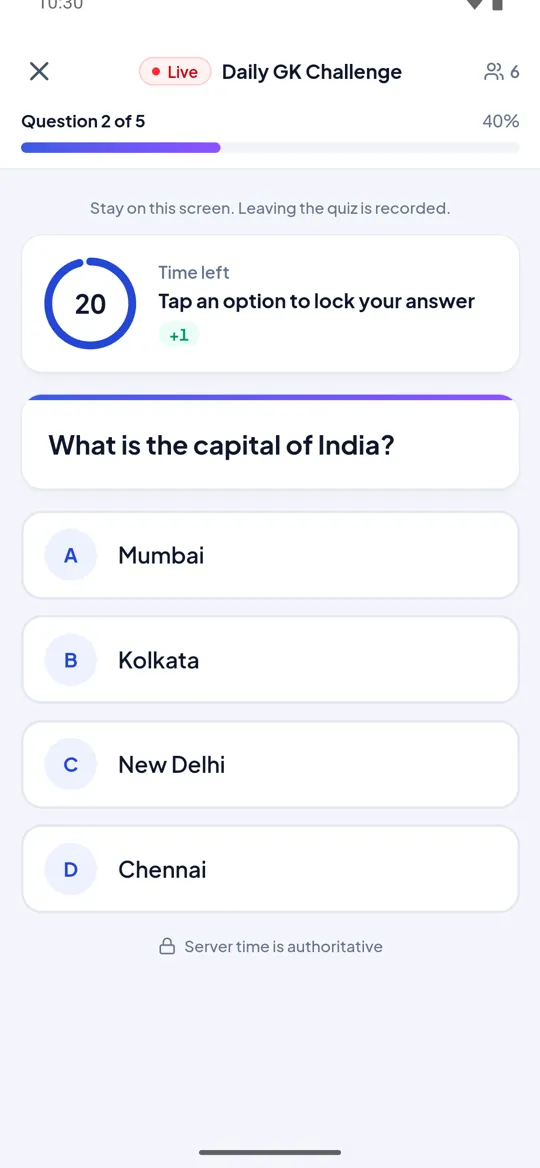
Live rounds on ExamLakshya begin at a fixed IST time, and every participant sees the same question as everyone else. The server sets how long each question stays open, so a patchy hill connection or a changed phone setting cannot change the outcome. The app has 11 languages, and a quiz has one answer key and one leaderboard however it is read. This page follows how the platform fits Gangtok’s hills, monasteries and study routines.
State services and the Secretariat lanes of Gangtok
A large share of Gangtok’s graduates aim at the Sikkim Public Service Commission, and the state secretariat is close enough that many candidates see the offices every day. That nearness makes the goal feel real, yet it also brings pressure, since a candidate can hear about a notice before it reaches the phone. The preliminary stage asks for a wide base in general studies, Sikkim’s own history and geography, and the current affairs of the year. Many candidates also keep a folder of current affairs clippings, which helps them see how a single story can produce several questions.
Live rounds on ExamLakshya give that base a rhythm. A candidate joins a fixed round on a set topic, and the server keeps the clock, so a weak hill connection cannot shorten a question. Once the round closes, the explanation sits beside each option. A finished round can be replayed for a state fact that keeps slipping, and the replay leaves the rank untouched. The performance screen then shows accuracy and rank quiz by quiz, so a candidate can see whether reading has become recall. A weekly target of three rounds on state topics and two on current affairs gives the preparation a clear shape. It is simple to track.
- State history and general studies in short rounds
- Current affairs of the year, tested regularly
- Accuracy and rank tracked quiz by quiz
Cab stands, steep roads and the climb up from MG Marg
Getting around Gangtok means working with the slope. The roads loop up and down the hillside, the cabs run between the main stands and the outlying localities, and the walk from MG Marg up to a rented room can be a serious climb. Cabs fill slowly in the afternoon, and a student who waits at a stand may use that time well or lose it entirely. On rainy days the roads take longer, so a student planning an exam slot should leave a generous margin before leaving home.
A live round suits the waiting. A candidate can join a short scheduled quiz while the cab fills, read the answer review on the ride, and replay a finished round in practice mode on the walk up. The site works in any mobile browser, and the Android app is downloaded from examlakshya.com/download, so nothing heavy needs carrying up the steps. If the signal fades on a bend in the road, the live room reconnects safely once the connection comes back. The routine works best when a round is chosen before leaving the house, so the choice does not depend on the mood of the day. That small decision saves time.
- Live round while the cab fills
- Answer review read on the ride up
- Practice replay on the walk back
Exams students in Gangtok prepare for
School students in Gangtok and the Class 12 evening
Gangtok’s schools prepare students for the Class 10 and Class 12 board papers, and the years before those papers are when habits form. Parents here often want to know whether the time on a phone is a waste or a gain. A scheduled quiz at a fixed evening hour gives a clear answer: the student plays one round, sees the result the moment it closes, and reviews the questions that were missed. Teachers in the upper classes often ask pupils to explain a chapter aloud, and the same habit helps when a quiz question needs a careful reading.
For a school student the value lies in the habit rather than the score. A short evening round followed by a careful review of the correct answers builds the habit of checking work, which carries into the examination hall. A quiz keeps the same numbering in all of its languages, so a pupil can read the wording in one language and confirm a scientific term in another, English and Hindi included. A reminder comes ahead of the evening round and another when the marks are posted. Parents see a weekly accuracy picture on the analytics screen, enough to tell whether the evenings are being used well. Families who want a clear view of progress can look at the weekly accuracy line rather than a single mark.
- A single evening round kept at the same hour
- Many languages, one shared scoreboard
- A weekly accuracy line for the family
What you get with ExamLakshya in Gangtok
Practise from anywhere in Gangtok
Tadong
The area around Sikkim University at 6th Mile, where students attend lectures and labs. Short rounds between classes fit the campus day well.
Tibet Road
A busy central road with shops, cafes and rented rooms above them. Students often read the morning news here before a lecture or a shift.
Arithang
A residential and commercial area with rented flats. A late-evening round suits those who study after a long day in town.
Sichey
A quieter hillside locality where families rent rooms to students. Its distance from the centre makes it a good base for replays on the walk home.
Development Area
A central neighbourhood near the offices and the market. Candidates who visit the state offices for forms often use a break for a short quiz.
Ranipool
A town to the south of the capital, where some students and workers commute from. The ride is a useful slot for a short revision round.
Kanchenjunga, the monasteries and the year Sikkim joined the Union
Sikkim’s history and culture are a common subject in state examinations. Candidates are expected to know when the state became part of India, which mountain the people revere, and which monasteries stand on the hills around the capital. Kanchenjunga, the third highest mountain in the world, is a central part of Sikkimese religious life, and Enchey and Rumtek monasteries are among the places most often visited by students and tourists alike. Visitors to the monasteries often ask about the murals and the prayer wheels, and a student who has seen them can link the facts to real places.
This local knowledge is easy to read and easy to forget, so repeated short rounds are more effective than a single long chapter. A question about a festival, a monastery or a river is best tested mid-session. Revision notes for upcoming rounds can be opened inside the app, searched and zoomed, so a candidate can confirm a date or a name before the timer begins. A visit to a monastery makes the same facts easier to recall later. A short round on the state’s festivals before a visit, followed by a round after it, is a simple way to check what stayed in memory.
- Kanchenjunga, monasteries and festivals as topics
- Statehood and the rivers of the state
- Revision notes searchable inside the app
A study day in Gangtok, hour by hour
- Morning walk above the townA short climb before the streets fill with traffic, with one question from yesterday’s review held in mind for the day. Keep the walk short.
- Lecture at TadongClasses or a coaching session fill the morning. Unclear points are marked, and Mitra AI can explain them in English or Hindi later. Keep the notebook close.
- Lunch and a short roundA quick general knowledge round after lunch. The server holds the clock, and the review separates a sound answer from a lucky one. Keep it short.
- Notes at the tableOpen the PDF notes for the next live round, search for a place name and zoom into the state map. Copy any hard line into a notebook.
- Evening round from the houseSit down at the scheduled hour in a quiet corner of the house. Scores and the leaderboard arrive once the final question is closed. Be signed in a few minutes early so nothing is lost.
- Replay and a note on weak topicsGo back over one earlier round in practice, where the rank stays put, then write down the three subjects that gave the most wrong answers. Glance at the week’s accuracy before bed.
Try a Gangtok GK round
Five quick questions about Gangtok and Sikkim. Tap an option to lock your answer, just like in a live quiz.
Sikkim became the 22nd state of India in which year?
Show answer
Answer: C. 1975 — Sikkim became a state of the Indian Union in 1975, as the 22nd state. Earlier, it had been a protectorate, and the other years in the list belong to different events in the country’s history.
Pang Lhabsol, a major festival in Sikkim, honours which mountain?
Show answer
Answer: B. Kanchenjunga — Pang Lhabsol is observed in honour of Kanchenjunga, the mountain that Sikkimese people regard as a protector. Everest, Nanda Devi and Dhaulagiri lie outside the state.
Rumtek monastery, near Gangtok, belongs to which Buddhist tradition?
Show answer
Answer: B. Kagyu — Rumtek is a major monastery of the Kagyu tradition and is the seat of the Karmapa in exile. Enchey, another monastery near the capital, belongs to the Nyingma tradition.
The Namgyal Institute of Tibetology, a research centre for Himalayan studies, is located in which city?
Show answer
Answer: A. Gangtok — The Namgyal Institute of Tibetology is based in Gangtok and works on Tibetan and Himalayan studies. Darjeeling is a hill town in West Bengal, while Shillong and Leh are capitals in other regions.
Which major river flows through Sikkim’s valleys and joins the Brahmaputra system?
Show answer
Answer: D. Teesta — The Teesta flows through Sikkim and forms the valley below Gangtok. The Subansiri, Kosi and Manas are rivers that flow through other parts of the region.
Women aspirants who study from hillside homes in Gangtok
Many women aspirants in Gangtok study from home, in a family house on a hillside or in a rented room shared with a sister or a cousin. Household duties, the steep walk to a coaching room and the cost of travel can make a regular class routine hard to sustain. Studying from home is a sensible choice for many, but it needs a clear structure so the day does not dissolve into chores. Some families share a small study table in the main room, so a candidate may need to schedule a round around a younger sibling’s homework.
A live quiz gives that structure without the need to travel. A fixed evening round, joined from a corner of the house, marks the start of a study block and its end. The leaderboard offers a fair comparison with other candidates across the state, and the answer review gives a reason for each correct option. Practice replays can be taken in the quiet hours, and Mitra AI can explain a difficult question in English or Hindi. Setting the same time each evening makes the routine easier for everyone at home to respect. The household notices the boundary. Consistency is the point.
- A fixed evening round as a study boundary
- Fair comparison with candidates across the state
- Replays in the quiet hours of the house
How to pick the best quiz app in Gangtok
- A timer kept by the server, so a slow hill connection or a changed phone clock gives nobody an edge over the rest of the room.
- Matching English and Hindi wording for every quiz, marked on one answer key, so a student from Namchi and one from Tadong are ranked on the same paper.
- Scores and an explained answer key appear as soon as the timer ends, so a misconception can be fixed before the next class at Tadong.
- Full-length mocks with a timed question palette, a review flag and a section breakdown, so the pace of a long paper can be practised in advance.
- Runs on an inexpensive phone from a hillside room, with a night theme, and keeps the display lit while a question is open.
- Revision PDFs read inside the app with search and zoom, which spares a student from carrying printed notes up a slope.
Questions students in Gangtok ask
Is there a best quiz app near me in Gangtok for SPSC practice?
A useful quiz app should keep the timing fair, explain each answer and offer practice in English and Hindi. It should also provide mock tests in a format close to the real paper. ExamLakshya meets those needs with timed live rounds, a server-kept clock, explanations when each round finishes, and full-length mocks that break the score down by section. Take the free trial and decide whether its pace suits your routine.
Can students in Gangtok and the districts join the same live rounds?
Yes, provided there is mobile data or Wi-Fi. Because the platform is online, a student in a room at Tibet Road, a family house in Ranipool or a home in a district town can join the same round at the same moment. Everyone appears on one leaderboard, and there is no centre to visit.
Which languages are offered, and can Mitra AI answer in Hindi?
Eleven languages are available in all, from English and Hindi to Tamil, Odia and Assamese. Questions match across the languages a quiz is published in, and the answer key and timer stay the same. Mitra AI replies in Hindi and in your other study language. Nepali, widely spoken across the state, is not offered, so practise in English, Hindi or another of the eleven that you read.
Is the trial free, and what happens once it finishes?
Each new account gets one free trial per mobile number, and no card is needed to start. The trial covers live rounds, study material, mock tests and questions to Mitra AI. Afterwards, paid plans are available if you want to keep going, and the choice rests with you once you have tried the app.
Do I need a laptop, or is a phone enough for SPSC practice?
A phone covers most of the work. Open the platform in any phone browser, or install the Android app from examlakshya.com/download. A laptop is easier for a long mock test with a question palette, but live rounds, replays and notes all run comfortably on a phone.
Does the Sikkim Public Service Commission recognise ExamLakshya?
It does not. ExamLakshya has no relationship with the commission, and it does not provide a test series that the commission has approved. The practice covers general knowledge, current affairs, reasoning, aptitude and state history under timed conditions. Eligibility, dates and the syllabus should be checked on the commission’s own website.
How can a student who travels in from Namchi or Mangan keep a steady routine?
Choose one or two live rounds that fit the journey home, and turn on reminders. A round missed because of a late cab can be replayed later in practice mode without changing the rank. Keeping a weekly mock test on the calendar shows whether the routine is working, and the analytics screen tracks accuracy by subject.
Can Class 10 and Class 12 students in Gangtok use the app alongside school?
Yes. Quizzes cover school subjects alongside general knowledge, so a student can take a short evening round on a school day and keep the longer sessions for Sunday. Any finished quiz can be retried whenever a doubt remains. A physics or chemistry doubt can go to Mitra AI, which lays out the reasoning in steps, and a parent can check the weekly accuracy figures.
Gangtok’s students climb a great deal, both on the roads and in their preparation, and the steady ones are the ones who keep a routine that suits the hills. Create a free ExamLakshya account tonight, choose whichever round comes up first on the weekly list, and see how much of the state’s history is still with you, in English or Hindi. Your first round is one tap away.